
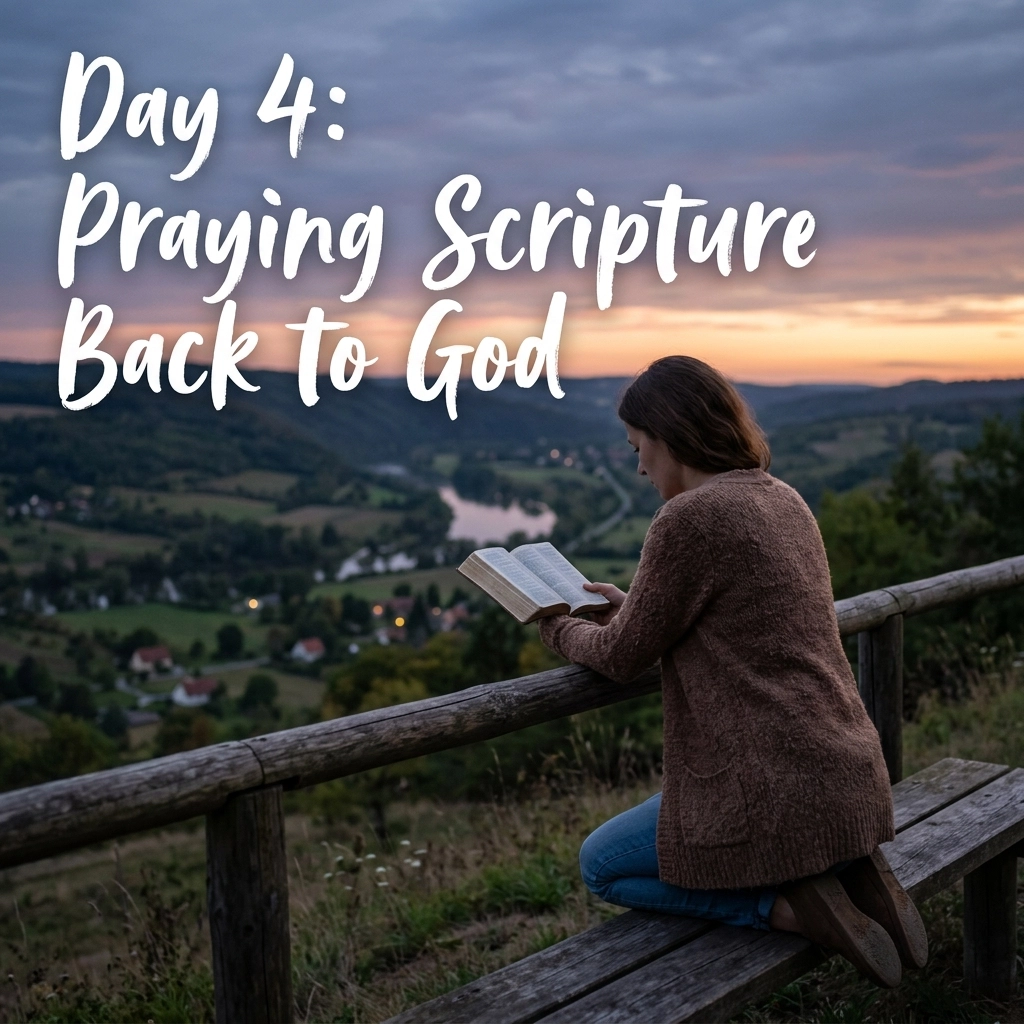
God gave you His Word. Now He invites you to give it back.
This is the practice of praying Scripture back to God: taking His words from the Bible and speaking them directly to Him in prayer. It is one of the most powerful ways to pray, and yet many Christians have never tried it.
Today, we explore why this practice transforms prayer, and how you can begin.
What Does It Mean to Pray Scripture?
Most people read the Bible and then pray separately. Praying Scripture combines both. You read a passage, and then you speak it back to God as your own prayer.
For example, you read Psalm 23:1: “The Lord is my shepherd, I shall not want.” Then you pray: “Lord, You are my shepherd. I trust You to provide everything I need. I bring my lack to You now.”
You are not adding to Scripture. You are letting Scripture shape your words to God.
This is not a technique or a formula. It is a conversation where God speaks first, through His Word, and you respond from the heart.
Why God’s Word Is Different from Any Other Words
Before we learn how to pray Scripture, we need to understand why Scripture is worth praying at all.
The Bible is not simply an old religious book. It is the living Word of God, active and powerful in ways that human words are not.
The writer of Hebrews says this clearly:
“For the word of God is living and powerful, and sharper than any two-edged sword, piercing even to the division of soul and spirit, and of joints and marrow, and is a discerner of the thoughts and intents of the heart.” (Hebrews 4:12, NKJV)
Notice the language. The Word is living. It is not a dead text from the past. It is active right now. It is powerful, which means it does something when you engage with it. It goes deeper than human speech, reaching the innermost parts of who you are.
This is why praying Scripture is different from simply repeating spiritual phrases. When you bring God’s own Word back to Him in prayer, you are not just expressing feelings. You are praying in alignment with what God has already declared to be true.
John Wesley, the 18th-century preacher who led thousands to Christ across England, once said:
“I want to know one thing: the way to heaven. God Himself has condescended to teach me the way. He has written it down in a book. O give me that book.”
Wesley understood that God’s Word was not optional content for the believer. It was the very voice of God. Praying it back was simply answering that voice.
A Light for Every Prayer
King David understood this intimately. He did not just study the law of God as an academic subject. He treasured it, meditated on it, and spoke it back to God constantly.
He wrote:
“Your word is a lamp to my feet and a light to my path.” (Psalm 119:105, NKJV)
This image is precise. A lamp does not illuminate everything at once. It shows you the next step. When you are unsure what to pray, when your heart is confused or overwhelmed, the Word becomes that lamp. It shows you what to bring to God. It gives your prayer direction.
Many believers sit in silence, unsure what to say to God. Praying Scripture solves this. You do not need to find the right words. God has already provided them.
What the Student Learned by Reading Aloud
There is a kind of learning that happens only through repetition and the voice.
Students who study English in Cambodia often discover this. Reading silently can be passive. But reading aloud, slowly, carefully, repeating a sentence until you feel it inside your chest, that is when understanding comes.
A young woman in Phnom Penh, preparing for university entrance exams, had developed this habit with her English textbook. She would read the same paragraph again and again, out loud, until she could not just recite it but feel what each sentence meant.
She brought this same practice to her Bible. She had started attending a small church, and an older woman there encouraged her to try praying the Psalms. She chose Psalm 23 and read it aloud every morning for a week. By the fourth day, she was no longer just reading. She was speaking the words to God. “Even though I walk through the valley of the shadow of death, I will fear no evil, for You are with me.” She wept when she said that. Not because she was sad, but because she realized she believed it.
This is what Scripture does when you speak it back to God. It moves from information to conviction.
Charles Spurgeon, the 19th-century English preacher known as the Prince of Preachers, understood this process deeply. He wrote:
“Visit many good books, but live in the Bible.”
Living in the Bible means more than reading it. It means letting it live in you, shaping your prayers and your speech and your faith.

)
Praying That Your Words Please God
Not everyone who prays Scripture does so with confidence. Some believers worry: Are my prayers good enough? Do my words reach God? Am I saying the right things?
David prayed about this directly:
“Let the words of my mouth and the meditation of my heart be acceptable in Your sight, O Lord, my strength and my Redeemer.” (Psalm 19:14, NKJV)
This is already a prayer that can be prayed. Before you begin your prayer time, speak these words back to God: “Lord, let the words of my mouth and the meditation of my heart be acceptable in Your sight.”
You are asking God to receive your prayer. You are acknowledging that He is the audience, the judge, and the encourager. You are coming to Him in humility.
A.W. Tozer, the 20th-century pastor and author of The Pursuit of God, wrote:
“What comes into our minds when we think about God is the most important thing about us.”
When you begin prayer with Psalm 19:14, you are orienting your whole mind and heart toward God. You are reminding yourself who you are speaking to. That changes how you pray.
God’s Word Does Not Return Empty
One of the most reassuring truths about praying Scripture is this: God has already promised that His Word accomplishes what He sends it to do.
God spoke this through the prophet Isaiah:
“So shall My word be that goes forth from My mouth, it shall not return to Me void, but it shall accomplish what I please, and it shall prosper in the thing for which I sent it.” (Isaiah 55:11, NKJV)
When you pray Scripture, you are not hoping your prayer might work. You are praying words that God Himself has guaranteed will not return empty.
This is not magic. It is covenant. God has bound Himself to His Word. When you pray His Word back to Him, you are standing on ground that cannot move.
This truth is especially important when you are praying for something you cannot see yet. Maybe you are praying for a family member who does not follow Christ. Maybe you are praying for provision in a difficult financial season. Maybe you are praying for healing. You do not need to manufacture faith. You simply need to take the promises God has already made and bring them back to Him in prayer.
Live It Today
Here is how to begin praying Scripture, starting today.
Choose One Passage
Pick one of the four passages from today: Psalm 119:105, Psalm 19:14, Hebrews 4:12, or Isaiah 55:11. If you are unsure, start with Psalm 19:14. It is a natural prayer for the beginning of any prayer time. If you missed the start of this series, you can catch up with Day 1, Day 2, and Day 3.
Read It Aloud Three Times
Read the passage slowly, out loud. Three times. Do not rush. Let the words land in your ears and your heart. This is the practice the young student in Phnom Penh discovered: the voice activates understanding that the eyes alone sometimes miss.
Speak It Back to God in Your Own Words
After reading, close your eyes and speak the verse back to God in first-person prayer. Change “Your word is a lamp” to “Lord, Your Word is a lamp to my feet today. Show me my next step.” Change “it shall not return to Me void” to “Father, I trust that Your Word is working, even when I cannot see it yet.”
You are not changing Scripture. You are applying it personally.
Write One Sentence in a Journal
After praying, write one sentence: what did this verse stir in you? It does not need to be long. It does not need to be eloquent. One honest sentence is enough. This builds a record of how God speaks to you through His Word over time.
Return to the Same Passage Tomorrow
Do not move to a new verse every day this week. Stay with one passage for three to four days. Repetition is not spiritual weakness. Depth comes from dwelling, not from covering more ground.
A Final Word
The Bible is not a textbook to master. It is a letter from a Father who wants to hear from His children.
When you pray Scripture back to God, you are telling Him: “I receive what You have said. I believe it. And I am bringing it back to You now.”
That is not a complicated spiritual discipline. It is simply a conversation between a believer and the God who is always listening.
Begin today. Choose a verse. Speak it aloud. Pray it back. And watch what the living, active Word of God does in your heart.
If you want to talk about your faith journey or have questions about Christ, reach out to Naleng Real at https://nalengreal.com. Naleng would be glad to walk with you.
I work with Cambodian and international Christian organizations, churches and Christian leaders to end gospel poverty, reaching the people at the marketplace through a holistic ministry approach.
Every article by Naleng →