
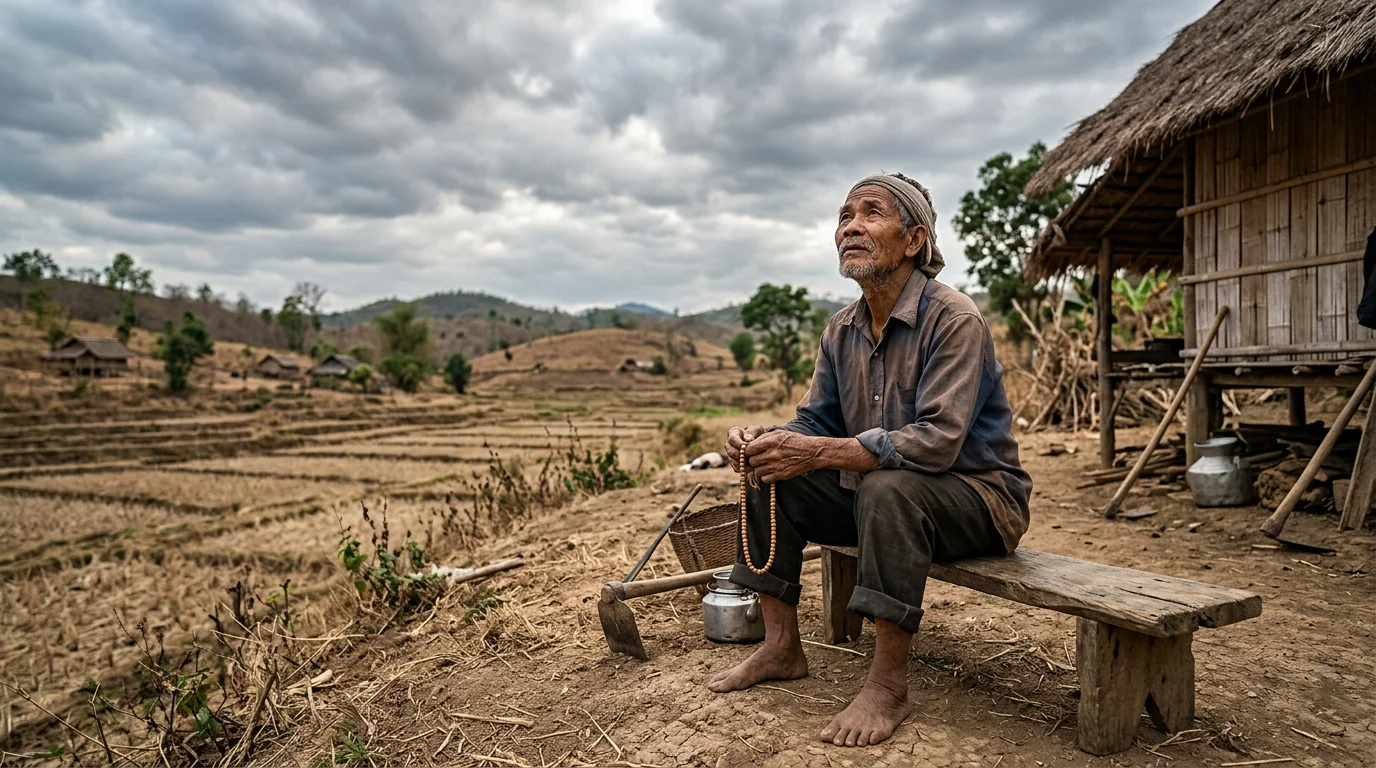
You have been praying. Days have passed. Maybe weeks. Maybe months. And heaven feels silent.
You wonder if God hears you. You wonder if you are praying wrong. You wonder if He even cares. That silence is one of the hardest places a believer can stand.
You are not alone in this struggle. Some of the most faithful people in Scripture stood in the same place. They cried out. They waited. They did not always receive what they asked for. And yet their faith did not collapse.
Today, on Day 6 of 30 Days of Prayer, we are going to face this question honestly: What do we do when God seems silent?
When Honest Prayer Sounds Like Complaint
Open your Bible to Psalm 13. David does not ease into this psalm gently. He opens with a raw, direct question:
“How long, O Lord? Will You forget me forever? How long will You hide Your face from me?”, Psalm 13:1, NKJV
Read that again. David is not being polite. He is not using religious words to soften his pain. He is telling God exactly how he feels: forgotten, hidden from, abandoned.
This is important. God does not ask you to pretend. He does not want your performance. He wants your truth.
David continues through verses 2 and 3, pressing God for an answer. He describes real suffering. He names his sorrow. And then, by verse 5, something shifts:
“But I have trusted in Your mercy; my heart shall rejoice in Your salvation.”, Psalm 13:5, NKJV
David does not receive an explanation. He does not get a reason for the silence. But he makes a choice: he trusts the character of God even when the circumstances have not changed.
That is not weakness. That is mature, costly faith.
The Prophet Who Dared to Ask Why
David was not the only one who prayed through silence. The prophet Habakkuk opened his entire book with a complaint to God:
“O Lord, how long shall I cry, and You will not hear? Even cry out to You, ‘Violence!’ and You will not save.”, Habakkuk 1:2, NKJV
Habakkuk watched his nation fall apart. He watched injustice go unpunished. He prayed and prayed and saw no change.
God did eventually answer Habakkuk. But the answer was not what the prophet expected. God's response was bigger and longer than Habakkuk's timeline. His plan was unfolding in ways Habakkuk could not yet see.
Charles Spurgeon, the great 19th-century English preacher, once said:
“God is too good to be unkind, too wise to be mistaken, and when you cannot trace His hand, you can trust His heart.”
That is exactly what Habakkuk had to learn. And that is what you may need to learn today. You cannot always trace God's hand in the silence. But you can always trust His heart.
A Farmer Waiting for Rain
In Cambodia, a farmer plants his rice and watches the sky. He does not control the rain. He cannot make the clouds come. He prepares his field. He works hard. And then he waits.

Some seasons, the rain is late. Days pass with dry heat. The soil cracks. The young farmer worries. He wonders if this will be the year the rain does not come.
But the rain always comes. Not always on his schedule. Not always in the way he expected. But the rain comes. And when it does, the fields that seemed hopeless grow green and full.
Unanswered prayer can feel like that cracked, dry field. You have prepared your heart. You have done the work of faith. You have cried out to God honestly. And the sky is still clear and empty.
Do not stop praying. The rain is coming. You do not control the timing, but you can trust the One who does.
The Parable Jesus Told About Not Giving Up
Jesus knew His disciples would struggle with this. He knew they would pray and feel like nothing was happening. So He told them a story. Luke 18 opens with this remarkable statement:
“Then He spoke a parable to them, that men always ought to pray and not lose heart.”, Luke 18:1, NKJV
The story is about a widow who kept returning to an unjust judge, asking for justice. The judge did not care about her. But she kept coming back. She did not give up. And eventually, her persistence wore him down.
Jesus then makes a powerful contrast. If an unjust, uncaring judge will eventually respond to persistence, how much more will your loving, attentive heavenly Father respond to His children?
“And shall God not avenge His own elect who cry out day and night to Him, though He bears long with them? I tell you that He will avenge them speedily.”, Luke 18:7-8, NKJV
Jesus is not saying God is like the unjust judge. He is saying the exact opposite. If even that judge eventually responded, God, who loves you deeply, will certainly answer you. The call is to keep praying. Do not lose heart.
John Wesley, founder of Methodism, understood this kind of persistent faith. He wrote and preached about prayer as a discipline of trust, not a technique for results. He believed that the act of coming back to God again and again shapes the believer's heart more than it changes God's mind. Persistence in prayer is not about convincing God. It is about aligning your heart with His.
When God Says No
There is one more passage we need to face honestly. Not all prayers are answered with yes. Some are answered with no, or not in the way you hoped.
The Apostle Paul knew this. He had a painful condition he called "a thorn in the flesh." He prayed three times for God to remove it:
“Concerning this thing I pleaded with the Lord three times that it might depart from me. And He said to me, ‘My grace is sufficient for you, for My strength is made perfect in weakness.'”, 2 Corinthians 12:8-9, NKJV
Paul did not get what he asked for. He got something better: a deeper experience of God's grace, and a revelation about where true strength comes from.
A.W. Tozer, the 20th-century American pastor and author of The Pursuit of God, wrote:
“God cannot fully bless a man until He has first conquered him.”
Sometimes the unanswered prayer is God's refusal to give us what we want so He can give us what we actually need.
That is not cruelty. That is love.
C.S. Lewis, the English author and Christian apologist, put it this way:
“I pray because I can’t help myself. I pray because I’m helpless. I pray because the need flows out of me all the time, waking and sleeping. It doesn’t change God. It changes me.”
When God says no, He is not abandoning you. He is working in you through the very pain of waiting. The silence is not rejection. It is often transformation.
Three Truths to Hold Onto
When prayer feels unanswered, anchor yourself to these three truths.
God hears every prayer. Psalm 34:15 says:
“The eyes of the Lord are on the righteous, and His ears are open to their cry.”
He is not distracted. He is not absent. He hears you.
God's timing is not our timing. Isaiah 55:9 says:
“For as the heavens are higher than the earth, so are My ways higher than your ways, and My thoughts than your thoughts.”
His perspective sees what you cannot yet see.
God's grace is enough for the waiting. Paul learned it. The widow in Jesus' parable modeled it. David sang it. You can live it.
Live It Today
Pray Honestly
Take 5 minutes today to tell God exactly what you feel about the silence. Do not use religious language to hide your real emotions. Follow David's example in Psalm 13. Name the pain. Name the questions. God is not fragile. He can handle your honesty.
Write Down What You Are Waiting For
Take a piece of paper and write one thing you have been praying about without seeing an answer. Beside it, write Psalm 13:5: "But I have trusted in Your mercy." Carry it with you today as a reminder that trust is a choice, not a feeling.
Commit to One More Week of Prayer
Jesus said to pray and not lose heart. Choose one prayer that you have almost given up on. Commit to praying it every day for the next seven days. Do not measure success by the answer. Measure it by your faithfulness to keep returning to God.
Ask God What He May Be Doing
Instead of only asking God to change your situation, ask Him what He may be doing in you through this season of waiting. Paul's thorn produced a revelation of grace. What might your unanswered prayer be producing in you?
Keep Coming Back to God
Unanswered prayer is one of the greatest tests of faith. But it is also one of the greatest teachers.
David learned to praise in the dark. Habakkuk learned to trust a timeline he could not see. Paul learned that weakness is where God's strength enters. The widow in Jesus' story learned that persistence matters.
And you can learn that the silence is not the end of the story.
Keep praying. Keep coming back. The God who hears every word you speak is working in ways you cannot yet see.
If you have questions about faith, prayer, or what it means to follow Jesus, reach out to Naleng Real at https://nalengreal.com. Naleng would be glad to walk alongside you.
And if you want to explore more about prayer and the Christian life, visit https://unboundedknowledge.org/ for more articles and resources.
